



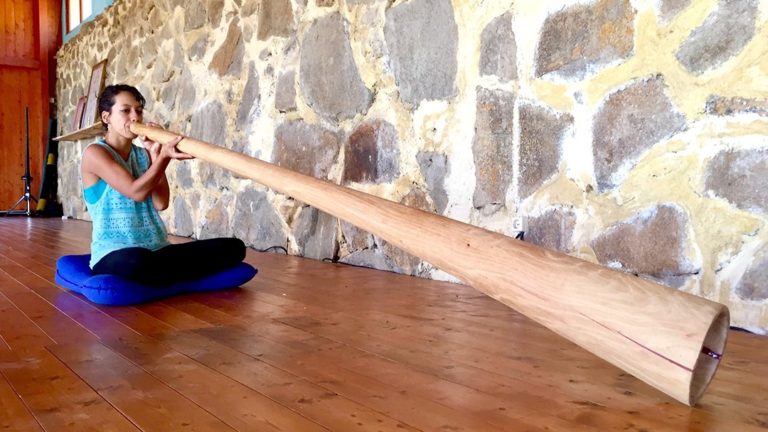
“Sorry… a what?” When I say I play the didgeridoo, this is often the reaction I get. So I learnt to say it slowly: a did-ge-ri-doo. Faces light up, but people still look doubtful.
The didgeridoo does not (yet) have the fame of the violin or the guitar. But this simple piece of wood has a lot to say. In this lesson, I explain what a didgeridoo is, where it comes from and how it works.
What is a didgeridoo?
A didgeridoo is a musical instrument that comes from the Aboriginal people of Australia. It is considered the oldest wind instrument in the world.
Traditionally, it is not called a didgeridoo. Depending on where it comes from in Australia, it is called yidaki or mago. It comes from the Northern Territory, in Arnhem Land.
A tube, and only a tube
Traditionally, a didgeridoo is a eucalyptus trunk that termites have hollowed out from the inside. When the tree is cut, it still looks like a tree: a big piece of wood with a hole inside. The maker then takes wood off the outside to make it thinner.
In the end, a didgeridoo is a tube with nothing inside. As long as it measures between 1.20 m and 1.80 m, any tube will do: a PVC vacuum-cleaner hose (choose a new vacuum cleaner!), or even toilet paper rolls stuck together. Of course, they will not all sound as good.
That is why some people specialise in making didgeridoos: a good instrument requires real expertise. Makers who work with eucalyptus choose the right trunks, so that the instrument needs as few changes as possible. Nature shapes the instrument, and the player’s job is to make music with it.
An instrument with one single note
The didgeridoo only plays one note. That is why there are didgeridoos in E, in C, in D.
A violinist changes notes. A didgeridoo player uses one single note and brings out its natural harmonics. That makes the didgeridoo very close to the jaw harp and to overtone singing. It is a one-note instrument, but it has many surprises for anyone who takes the time to listen.
How does a didgeridoo work?
If you think about what a didgeridoo really is, it is an amplifier for your body. You only need to move something inside your body to change the sound. Here are the parts you use.
1. The lips
The lips make the sound. When you make them vibrate, the sound comes out of the didgeridoo.
2. The tongue
Move your tongue as if you were saying “yo yo yo”, without your voice: this is what I call harmonics. Move it with consonants like T and K, as in “ta-ko ta-ko”, and you get another kind of sound.
3. The cheeks
Moving your cheeks also changes the sound. The cheeks are used for circular breathing and for dynamics.
4. The voice
You can also use your voice while you play, for strong contrast.
Combine everything
The most interesting part is to combine all of them. For example, I can use a little of the K from the tongue and more lips to get a more dynamic sound.
Then comes circular breathing. With circular breathing, I breathe all the time, and I use all these sounds to make rhythms. Listen to the end of the video to hear it.
Why I fell for this instrument
Its history, the way it is made and its technique make the didgeridoo a fascinating instrument, with unbeatable originality. That is what attracted me when I started. I was looking for an original instrument to learn, and I was not disappointed.
If you want to try it yourself, start with my step-by-step guide to playing the didgeridoo.






Leave a Reply
You must be logged in to post a comment.